Home
Home trust strip on Khaite
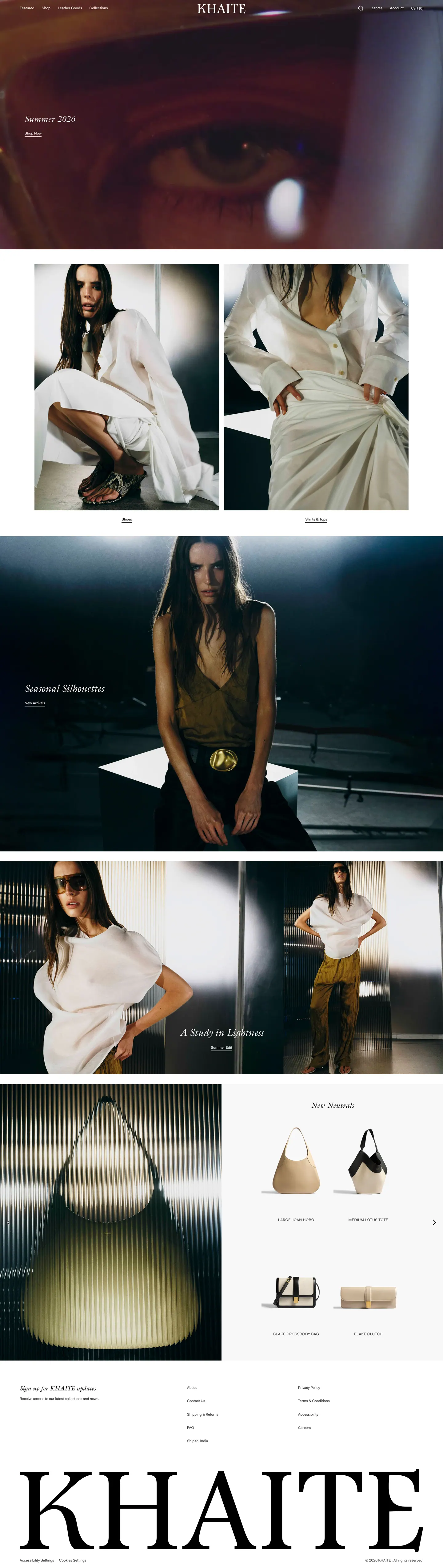
Recorded example of the home trust strip pattern on Khaite (home page). RecoverBase describes what this brand chose to publish and cites outside research. This is observation, not a promise of results for your store.
- Vertical
- Luxury fashion
- Stage
- Home
- Platform
- Shopify
- Verified
- 2026-05-18
- Confidence
- 0%
- Region
- US store
Start here
- You are viewing one pattern applied to one brand. Sections below spell out structure, UX research, trade-offs, and sources.
- On wide screens, use On this page at left to jump around, then open Screenshot for the capture.
First visit? A short strip under the site menu explains RecoverBase once. Dismiss it whenever you like.
Use a home trust strip when it directly answers a specific shopper question or reduces a real uncertainty at the decision moment. Otherwise, it adds visual noise, duplicates information, or burdens page performance. Zero of 7 sampled stores use this pattern.
What it is
A home trust strip works when it answers a specific shopper question or reduces uncertainty at the decision moment. Otherwise, it adds clutter and hurts performance.
- Use a home trust strip when it directly answers a specific shopper question or reduces a real uncertainty at the decision moment. Otherwise, it adds visual noise, duplicates information, or burdens page performance. Zero of 7 sampled stores use this pattern.
- Apply a home trust strip only when it answers a specific shopper question or reduces a real uncertainty on the homepage, visible at the decision moment.
- Skip the home trust strip if it duplicates obvious information, adds visual noise without reducing uncertainty, or negatively impacts page performance.
What research says
Home trust strips work when they reduce shopper uncertainty, not when they add visual noise.
- Home trust strips appear on the homepage. First-time visitors form an impression and decide whether to stay. Effectiveness depends on reducing real shopper uncertainty, not adding visual noise.
- A home trust strip's effectiveness is context-dependent. Evaluate it against the specific shopper question it aims to answer on the homepage. Do not apply it as a universal best practice.
- Shoppers process home trust strips in seconds. Clarity and a single obvious purpose outperform dense or decorative variants.
- Zero of 7 sampled stores implement this pattern.
Trade-offs
Home trust strips fail when they add scan cost and clutter without reducing uncertainty.
- The primary failure is adding scan cost and visual clutter without providing value. This happens when a home trust strip does not reduce real shopper uncertainty on the homepage, where first-time visitors decide whether to stay.
- A home trust strip backfires if it duplicates obvious information or adds visual noise without reducing real shopper uncertainty.
- Adding a home trust strip may negatively impact page performance if the page is already constrained, as the element adds weight.Inferred
Other ways to do it
Omit home trust strips if they duplicate information or add visual noise without clear benefit.
- When a home trust strip would duplicate obvious information or add visual noise without reducing uncertainty, consider omitting the element entirely.Inferred
- Prioritize page performance by avoiding elements that add weight without clear user benefit, especially if page load is already constrained.Inferred
Screenshot
Cropped capture from our pipeline; compare with the Start here skim above if you land here first.
Screenshot not available for this capture tier yet.
Signals
Optional thumbs-up or save. We use counts only as weak engagement hints.
Annotations
Manual notes
No manual annotations yet.